
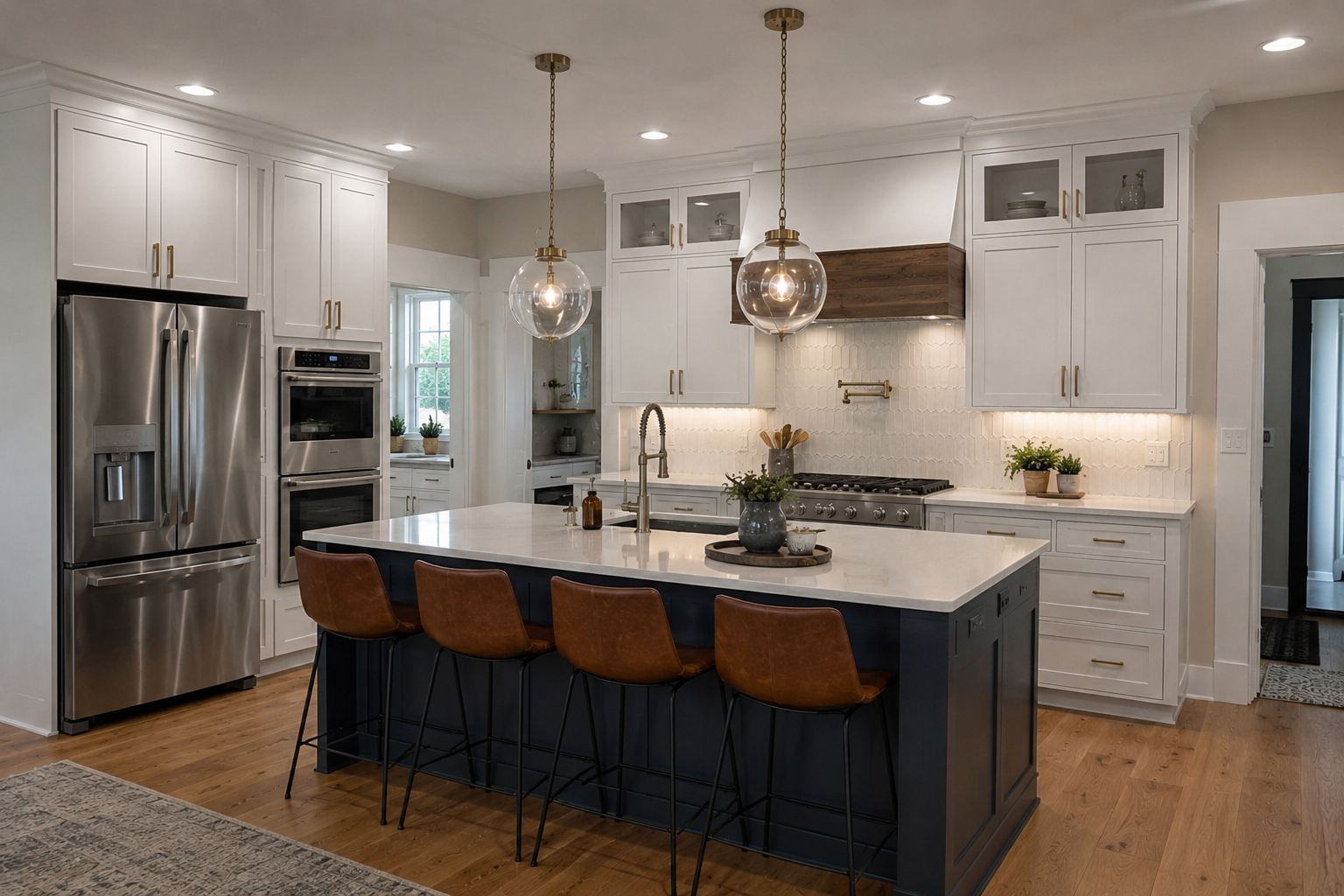
📅 May 27, 2025 | ⏱ 9 min read | Kitchen Remodeling Guide
The cabinets looked gorgeous on delivery day. Brand new. Clean lines. The homeowner sent us a photo — proud, excited, the project finally done. Eight months later, she called back. Two doors were sagging off their hinges, the finish around the sink was bubbling, and a drawer front had cracked clean through. She’d bought from a big-box store. Particleboard boxes, staple-joined frames, plastic cam locks holding the whole thing together. She spent $4,200 to do it twice.
We hear versions of that story constantly. Not just the cheap-cabinet story — the lighting story, the storage story, the “I didn’t budget for what was behind the walls” story. A Real Estate survey found 74% of homeowners have regrets after remodeling. That number doesn’t surprise us at all. What surprises us is how consistently the same ten kitchen renovation mistakes show up — over and over, completely preventable, usually discovered about six months too late.
We built this list from what we actually see: the questions customers ask before placing an order, and the calls we get after a remodel goes sideways. We’re a direct-to-consumer cabinet company that ships all-wood, fully assembled cabinets across all 48 contiguous states — we talk to homeowners deep in the planning process every single day. This isn’t recycled content. It’s what we’d tell a neighbor.
1. Not Planning for Enough Storage
Most Common Regret
Post-Remodel Complaint
Ask almost any homeowner six months after their remodel what they wish they’d done differently, and storage comes up first. Not the backsplash. Not the countertops. Storage. Because during the planning phase, you’re looking at empty cabinets in a showroom — and they look huge. Then you move your actual life back in.
Baking sheets. A stand mixer. Two sets of pots you keep meaning to donate. Fourteen spatulas. Backup paper towels. The good dishes that only come out at Christmas. It all has to go somewhere, and “somewhere” fills up shockingly fast. We’ve had customers tell us their brand-new kitchen was effectively full within three weeks of moving back in.
The trap is that storage is invisible when you’re making decisions about things you can see — cabinet door styles, countertop colors, hardware finishes. Nobody walks into a showroom and thinks hard about cubic footage. By the time they do, the order is already placed.
Before you finalize a single cabinet, physically walk your current kitchen and write down everything that needs a home. Every appliance, every pot, every odd-shaped pan that never fits anywhere. Then add 30% — because you’ll buy things. Prioritize deep base drawers over traditional shelved base cabinets for pots and pans (you’ll actually use them). Pull-out pantry towers recover dead wall space. Upper cabinets that run to the ceiling rather than stopping 18 inches short add meaningful storage without touching your footprint. More cabinets ordered now costs a fraction of what adding them later costs once the countertops are down and the tile is set.
2. Buying Cheap Kitchen Cabinets to Save Money
Expensive Mistake
We’re going to be direct about this one because it’s where we see the most damage, financially and emotionally. Cabinets are the most expensive line item in most kitchen remodels — typically 30–40% of the total budget — so the instinct to save money there is completely understandable. But the way most people “save money” on cabinets is by buying MDF or particleboard boxes instead of all wood kitchen cabinets with solid wood construction. And that decision tends to catch up with them.
Particleboard swells when it contacts moisture — and kitchens are full of moisture. Box joints held by staples rather than dovetails pull apart under daily load. Plastic cam locks strip out. Drawer glides fail. The finish peels at the edges first, then spreads. We’ve seen cabinets from certain big-box brands show real structural problems in under three years. Not cosmetic problems — structural ones. Doors that won’t close. Drawer boxes that separate from their faces. Bottom panels that sag.
Here’s the math that actually matters: a set of budget MDF cabinets at $3,500 that needs replacement in five years costs you $700 per year. A set of all-wood, KCMA-certified cabinets at $6,500 that lasts 25 years costs you $260 per year. The “cheaper” option costs nearly three times as much when you do it that way.
Look for: all-wood box construction (not MDF, not particleboard), KCMA certification (this is the industry’s actual durability and finish standard — not a marketing badge), dovetail drawer boxes, and soft-close hardware that doesn’t feel flimsy. Every cabinet we sell at CabinetsASAP is KCMA-certified, all-wood, fully assembled — not assembled by you in your driveway, but built and shipped ready to install.
When comparing cabinet prices, request the spec sheet, not just the price per linear foot. Ask specifically: is the box solid wood or MDF? Are the drawer boxes dovetail-joined? Does this carry KCMA certification? A salesperson who can’t answer those questions clearly is selling you something you don’t want. All-wood cabinets vs MDF isn’t a minor difference — it’s a 15- to 20-year difference in lifespan under real kitchen conditions.
3. Prioritizing Looks Over How the Kitchen Actually Works
Kitchen Layout Mistakes
You can have the most beautiful kitchen in your neighborhood and hate being in it. It happens more than you’d think. A kitchen designed from a Pinterest board instead of from how your household actually operates looks stunning in photos and makes weeknight cooking feel like an obstacle course.
The island that looked elegant in a 900-square-foot showroom becomes a traffic jam in a real 150-square-foot kitchen. The refrigerator tucked into a corner for visual symmetry means you’re walking six steps every time you need butter while something is burning on the stove. The tall cabinet run that looked dramatic on the rendering blocks natural light from the window you actually like. These tradeoffs are invisible on a floor plan and completely obvious the first time you cook a real meal.
The work triangle — the path connecting your sink, stove, and refrigerator — should have legs totaling between 12 and 26 feet. Short enough that you’re not running laps, long enough that you’re not constantly in your own way. When an oversized island cuts across it, or cabinet placement forces you to backtrack constantly, you feel it within a week.
Before finalizing any layout, run three specific scenarios in your head: making coffee on a Tuesday morning while someone else is making toast, cooking a weeknight dinner with kids underfoot, and hosting Thanksgiving where three people need to be in the kitchen at once. If any of those feel cramped or broken in your layout, they’ll be cramped and broken in real life too. Minimum 42 inches of clearance in work zones for one cook; 48 inches if two people regularly cook together. Lock that in before you decide anything about cabinet door styles or countertop colors.
4. Underestimating How Much Lighting You Need
Lighting
Most builder-grade kitchens come with one ceiling fixture in the middle of the room. Builders do this because it’s cheap and it passes inspection. Homeowners keep it because they’re focused on everything else during a remodel. Then the project wraps, the beautiful new cabinets are installed, and they stand there chopping vegetables in their own shadow wondering why the kitchen still feels dark.
Lighting is the one thing that makes a $15,000 kitchen feel like a $50,000 kitchen — or makes a $50,000 kitchen feel like a $15,000 one. Under-cabinet lighting alone changes how the entire space reads. It makes the countertops look better, makes the backsplash pop, and means you can actually see what you’re cutting. The three-layer approach — ambient overhead, task lighting directly over work zones, and accent lighting under cabinets and at the island — isn’t a luxury upgrade. It’s how a kitchen is supposed to work.
The frustrating part: lighting is genuinely cheap to rough in during a remodel and genuinely expensive to add after the fact. Retrofitting under-cabinet wiring after the backsplash is set means cutting into tile. Running new circuits after the walls are closed means patching drywall. This is one of those decisions where doing it right during the project costs maybe $800 more and doing it as a retrofit costs $3,000 more.
Tell your electrician about your lighting plan before cabinets go in — some configurations limit where ceiling cans can land. Rough in under-cabinet wiring at the same time as the rest of the electrical work, not afterward. Put island pendants and overhead recessed lights on separate dimmer circuits so you can dial them independently. Budget $2,000–$4,000 to do this properly. It’s consistently one of the highest returns on investment in a kitchen remodel, and it’s invisible in the worst possible way when it’s done wrong.
5. Choosing a Trendy Cabinet Style That Dates Quickly
Cabinet Selection
Open shelving was everywhere in 2018. Everybody wanted it. By 2022, a lot of those same homeowners were asking about cabinet doors because they were tired of dusting their dishes. The all-white kitchen felt crisp and modern in 2015. By 2021 it was starting to feel like every staging job on HGTV. Two-toned cabinets — navy lowers, white uppers — had a strong run. They still look good. But “had a strong run” is not a phrase you want to associate with something that costs $12,000 and takes two weeks to install.
White shaker cabinets have been the best-selling kitchen cabinet style in the US for over 20 years — not because designers ran out of ideas, but because they genuinely work with everything and don’t age. That staying power is worth something when you’re signing a check for a full kitchen.
Cabinets aren’t like a throw pillow. You can’t swap them out when you’re tired of them. When a trend fades and your cabinets are built around it, you’re either living with it for another decade or spending real money to change it. And if you sell the house with a kitchen that reads as dated, buyers notice. It shows up in offers.
Put your personality into the things that are easy to change: hardware, backsplash tile, paint, pendants, barstools. Put staying power into the things that aren’t: cabinet style and finish. Shaker doors in white, warm white, gray, or a deep navy are the most timeless kitchen cabinets available — they’ve outlasted every trend cycle for 20 years and show no signs of going anywhere. White shaker cabinets and gray shaker cabinets are genuinely timeless — not because they’re boring, but because they pair with everything and don’t ask to be noticed. A kitchen that ages well is one of the best returns on investment a remodel can deliver.
6. Skipping or Undersizing the Range Hood
Ventilation
Nobody thinks about ventilation until they fry bacon on a new gas range and spend the next 45 minutes fanning smoke off their brand-new cabinet doors. By then the grease is already working its way into the finish.
A recirculating range hood — the kind that filters air and blows it back into the room — does almost nothing against real cooking. It’s designed for apartments where ducting isn’t possible, not for gas ranges or serious cooking. An undersized ducted hood is better, but if the CFM rating doesn’t match your cooktop, you’re still leaving combustion byproducts, grease particles, and steam in the air of your kitchen. Over time that coats the upper cabinet faces, discolors the wall paint, and embeds in the wood of your cabinet boxes. We’ve seen beautiful new cabinets look dingy within two years because the hood situation wasn’t addressed during the remodel.
Plan the hood before you plan the upper cabinet run — because where the hood lands affects what upper cabinets can go where. The standard guideline is 100 CFM per linear foot of cooktop for wall-mounted hoods; if you cook on gas, size up. Always choose ducted (vented to outside) over recirculating if your layout allows it. This is one of those items people skip to save $400 and then spend $2,000 fixing later when the cabinets above the range start showing wear.
7. Not Budgeting for Surprises — and Running Out of Money
Budget Management
Nobody’s kitchen remodel comes in exactly on budget. Kitchen remodel costs almost always run higher than the original estimate — and the ones that don’t are usually the ones where nothing was opened up, nothing was moved, and nothing was behind the walls.
In older Connecticut and New England homes especially, pulling out the old cabinets is when the real story starts. Water damage from a slow drip nobody knew about. Knob-and-tube wiring that hasn’t been touched since 1962 and can’t legally stay. A subfloor that’s soft in two spots. A plumbing stack that needs rerouting because it runs exactly where the new island is going. None of these show up on a contractor’s estimate because none of them were visible. Every single one of them costs real money to fix — money that has to come from somewhere.
Homeowners who spend every dollar of their planned budget on the planned work are the ones who end up finishing with cheaper countertops than they wanted, skipping the under-cabinet lighting they’d planned, or carrying project debt at 22% on a store credit card.
Set aside 15–20% of your total project budget as untouchable contingency — not as money you expect to spend, but as insurance against the walls. On a $40,000 remodel that means keeping $6,000–$8,000 in reserve until the project is fully closed out. If nothing goes wrong, you keep it. On a typical remodel in a home that’s more than 20 years old, you’ll use at least some of it, and you’ll be relieved it was there.
8. DIYing Work That Should Be Done by a Professional
DIY Limits
YouTube has made every kitchen task look manageable. Some of them are. Cabinet installation is not one of them — not if you want it to look right in five years.
The problem isn’t that the task is conceptually hard. It’s that it requires a level of precision that compounds across the entire run. A floor that’s 3/8 of an inch out of level — completely normal in a real house — has to be shimmed and accounted for starting with the first cabinet. If it isn’t, every cabinet after it is wrong, every door gap is uneven, and every drawer has a slight drag that never goes away. A 1/4-inch error early in a 12-foot cabinet run can translate into a 3/4-inch gap at the other end. That’s visible. That looks like bad work, and it is bad work — just not always intentionally bad work.
We ship fully assembled cabinets specifically because they’re structurally complete out of the box — no assembly variables, no cam lock uncertainty. But even with perfectly built cabinets, a poor installation undoes the quality of the product. The cabinets are only as good as the install.
There’s plenty of DIY-able work in a kitchen remodel: painting walls, swapping hardware, installing a backsplash, even hanging upper cabinets if you genuinely know what you’re doing. But cabinet installation, countertop templating, electrical, and plumbing belong with licensed professionals. A pro installation on quality assembled cabinets takes 1–2 days and gets it right. A DIY installation on the same cabinets that takes a weekend and leaves every door slightly off will bother you for as long as you live in that house.
9. Treating Countertops as an Afterthought
Countertops
Here’s a specific, avoidable mistake we see in the ordering process: homeowners select their cabinet style and finish first, then pick a countertop from whatever is left in the budget. The cabinet door sample sitting alone on a showroom table looks completely different from the same door sitting next to three countertop slabs in your actual kitchen light. Colors read differently. Undertones emerge. The warm white cabinet that looked perfect next to a cool white quartz in a showroom looks slightly off next to that same quartz under your kitchen’s south-facing afternoon sun.
Beyond the visual issue, there’s a practical one: if the countertop choice gets pushed to the end of the planning process, it often gets pushed to the end of the budget too. That’s when people settle — for a laminate instead of quartz, for a thinner slab edge profile, for a color that’s “close enough.” Close enough in a kitchen that cost $45,000 feels like a real compromise every single morning.
Select your cabinet door sample and your countertop sample at the same time, and evaluate them together in your actual kitchen — not in a showroom. Budget for the countertop you actually want before you commit to any other line item. In most kitchens in 2025, quartz is the practical choice: it’s durable, nearly maintenance-free, and comes in enough variation to work with any cabinet color. For islands specifically, butcher block adds warmth that quartz can’t replicate. One decision that will make your cabinets look more expensive: don’t skimp on the edge profile. A thicker, more detailed edge makes the whole counter read as higher quality.
10. Designing Only for Today — Not the Next 15 Years
Long-Term Thinking
You’re not designing this kitchen for the day it’s finished. You’re designing it for a Tuesday night in 2031 when you’re tired from work and just trying to get dinner on the table. The version of you that exists then will have different kids (older, taller, have their own opinions about where things go), maybe different physical needs, definitely a different relationship with the space than you have right now standing in a half-demolished kitchen making decisions under pressure.
We see two flavors of this mistake. The first is designing for current household size without accounting for growth — not enough storage, not enough counter space, an island that works for two but not for four. The second is designing so specifically around current taste that the kitchen reads as a snapshot of 2025 rather than a durable investment. The homeowner who puts in a kitchen they love today and has to redo it in seven years because it no longer works for their life — or because it can’t sell the house — spent twice what they needed to.
Think through your household in five-year increments: what does it look like in 2030? 2035? If kids are young now, you’ll want more bulk storage than you think. If there’s any chance aging parents join the household, wider clearances and lower cabinet heights matter. If resale is a possibility within ten years, timeless over trendy is worth real money at closing. The kitchens that age best — that people are still happy with fifteen years in — are the ones designed around how people actually live in them, not how they photograph.
Quick Reference: 10 Kitchen Remodel Mistakes at a Glance
| # | Mistake | Impact |
|---|---|---|
| 1 | Insufficient storage | Daily frustration, clutter |
| 2 | Cheap cabinet construction | Failure within 3–5 years |
| 3 | Style over function layout | Broken workflow, cramped prep |
| 4 | Poor lighting plan | Dark, unusable prep zones |
| 5 | Trendy cabinet style | Looks dated, hurts resale |
| 6 | Undersized range hood | Grease buildup, air quality |
| 7 | No contingency budget | Project stalls, inferior finishes |
| 8 | DIY cabinet installation | Crooked cabinets, safety issues |
| 9 | Countertop afterthought | Budget overruns, design regret |
| 10 | Short-term design thinking | Premature re-remodel |
Related From CabinetsASAP
- Shop White Shaker Kitchen Cabinets — KCMA Certified, Fully Assembled
- Shop Gray Shaker Kitchen Cabinets — All-Wood, Ships in 5–8 Days
- Browse All 54 Cabinet Styles — 13+ Collections
- Get a Free Kitchen Quote — Homeowner & Contractor Pricing
Frequently Asked Questions About Kitchen Remodel Mistakes
What is the #1 regret homeowners have after a kitchen remodel?
Storage — consistently, by a wide margin. Homeowners make cabinet style decisions early and cabinet count decisions late, by which point the budget and floor plan feel locked in. The result is a kitchen that looks exactly how they imagined and holds about 70% of what they own. The fix is simple but has to happen early: inventory everything that needs a home before you finalize a single cabinet dimension.
How do I avoid buying cheap cabinets I will regret?
Ask for the spec sheet, not just the price. The questions that matter: Is the cabinet box solid wood or MDF/particleboard? Are the drawer boxes dovetail-joined or staple-joined? Does this product carry KCMA certification? If the salesperson can’t answer those questions clearly, walk. At CabinetsASAP, every cabinet we sell is all-wood construction, KCMA-certified, and ships fully assembled — not flat-packed for you to assemble in your garage.
Is it better to buy assembled or RTA kitchen cabinets?
Fully assembled all-wood cabinets are more structurally consistent, faster to install, and remove the variable of assembly quality from the equation entirely. RTA cabinets can work well — if the box construction is solid wood (not MDF) and the installer is experienced. How long RTA cabinets last depends entirely on that box construction: solid wood RTA can last 20+ years; particleboard RTA often shows real problems in 3–5. We offer both at CabinetsASAP; assembled cabinets ship in 5–8 business days, RTA in 3–5. And if you’re ordering kitchen cabinets online — from us or anyone — the most important thing to verify before you click buy is what the box is made of, not what the door looks like.
What cabinet style won’t go out of style?
Shaker in white, warm white, or gray — not because they’re the safe choice, but because they’ve proven it over 25 years of trend cycles and haven’t lost their appeal. They pair with every countertop material, every hardware finish, every backsplash option. They photograph well, they sell well, and they don’t ask to be the main character in the room. That last part is actually a feature: the best kitchen cabinets are the ones that make everything else look better without drawing attention to themselves.
Ready to remodel without the regrets? Start with the right cabinets.
KCMA-certified, fully assembled, all-wood cabinets — direct to your door in 5–8 days. Free shipping over $3,500.


Leave a reply