📅 Updated June 1, 2026 | ⏱ 7 min read | Cabinet Construction Guide
A customer called us last year — traditional New England farmhouse, planning to sell in five years, small galley kitchen. She had a spreadsheet. She’d read everything. She still couldn’t decide between framed and frameless. We talked for twenty minutes. She went framed. Called us six months after installation to say it was the right call. The kitchen looked exactly right for the house, and her contractor said it was the smoothest install he’d done all year. We sell both. More than 1,750 framed cabinet options and more than 2,150 frameless ones. So when homeowners ask us which is better, we’re not going to tell them one is obviously superior — because it genuinely depends. But we do have a real opinion about which one most homeowners end up happier with, and we’re going to give it to you straight rather than end with “both are great, it’s a personal choice.” This guide covers the actual differences — construction, cost, storage, installation, and resale — and ends with a direct recommendation based on what we see every day.Framed vs Frameless Cabinets: What the Construction Difference Actually Means
The basics
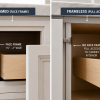
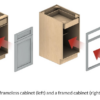
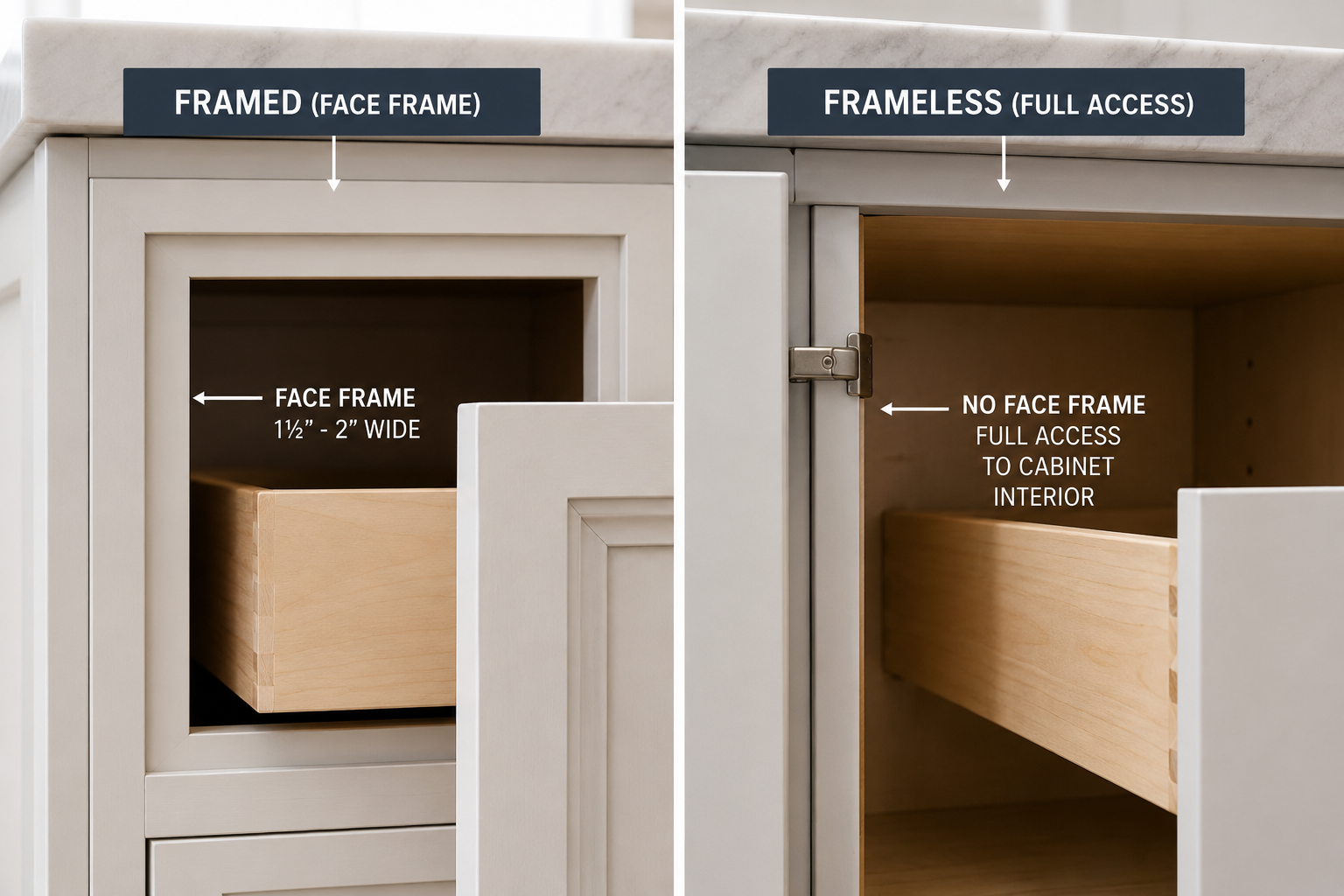
Most explanations of framed vs frameless cabinets read like a woodworking textbook. Here’s the version that matters when you’re deciding what to order. If you grew up in a house built before 1990, you almost certainly had framed cabinets — that’s how most American kitchens were built for decades. Frameless is the European style that started gaining real traction here around the 2000s. Framed cabinets (also called face frame cabinets) have a solid wood frame attached to the front of the cabinet box. It’s typically 1.5 inches wide and runs around the entire cabinet opening. Your doors and drawer fronts mount to this frame. The frame adds structural rigidity, gives the cabinet its traditional American look, and makes installation more forgiving because small gaps can be hidden behind the frame lip. Frameless cabinets have no face frame. The kitchen cabinet box construction is thicker — typically 3/4 inch side panels — to compensate for the missing frame rigidity. Doors mount directly to the sides of the box. The result is a cleaner, flatter look with no visible frame, and about 10–15% more usable interior space because there’s no frame eating into the opening width. Neither is structurally inferior when built correctly from quality materials. The difference is in look, feel, installation, and what they’re better suited for — which is what the rest of this guide covers.Framed Cabinets — Key Characteristics
- Solid wood face frame on cabinet front
- Traditional American-style look
- More door style options (inset, partial overlay, full overlay)
- More forgiving installation on uneven walls
- Slightly less interior storage space
- Generally 10–15% less expensive than frameless
- 55–60% of US cabinet installations
Frameless Cabinets — Key Characteristics
- No face frame — doors mount to box sides
- Clean, contemporary European-style look
- Full overlay doors only
- Requires more precise installation
- 10–15% more usable interior space
- Generally 10–15% more expensive than framed
- 40–45% of US cabinet installations
Are Frameless Cabinets More Expensive Than Framed? The Real Cost Difference
The numbers
Frameless cabinets typically cost 10–15% more than equivalent framed cabinets. That’s the honest number — not the marketing answer, not the “it depends” answer. The reason is construction: frameless cabinets require thicker box panels, more precise hardware (European-style hinges, drawer slides that mount to the box instead of a frame), and tighter manufacturing tolerances. All of that adds cost. At CabinetsASAP, the price gap between our framed and frameless lines reflects this — frameless isn’t dramatically more expensive, but it is consistently more expensive on an apples-to-apples comparison. We see homeowners talk themselves into frameless because the storage math sounds compelling. Rarely is storage the actual deciding factor — usually it’s the look they want. Which is a completely valid reason. Just be honest with yourself about what’s driving the choice. Here’s the nuance that sometimes changes the math: because frameless cabinets have 10–15% more usable interior space per cabinet, you might need fewer cabinets to achieve the same storage. In a small kitchen where you’re counting every cubic inch, that can offset some or all of the price premium.| Factor | Framed | Frameless |
|---|---|---|
| Typical cost premium | Base price | 10–15% more |
| Interior storage space | Standard | 10–15% more per cabinet |
| Door style options | Inset, partial overlay, full overlay | Full overlay only |
| Installation difficulty | More forgiving | More precise required |
| Best kitchen style | Traditional, transitional, farmhouse | Contemporary, modern, minimalist |
| Resale appeal | Broader buyer appeal | Stronger in modern markets |
| US market share (2026) | 55–60% | 40–45% |
Frameless Cabinets Are Harder to Install — Here’s Why It Matters
What installers know
This is the difference most homeowners don’t think about until they’re mid-installation. Frameless cabinets installation requires walls and floors to be close to plumb and level before a single box goes up. Framed cabinets are forgiving. The face frame provides a built-in margin for adjustment — small gaps between cabinets and walls, minor unevenness in floors, walls that are slightly out of plumb. All of these get absorbed or hidden by the frame. An experienced installer can make framed cabinets look perfectly level even when the wall they’re going on isn’t. Frameless cabinets require walls and floors to be close to plumb and level before the cabinets go in. Without a face frame to absorb small variations, misalignment shows. Gaps show. If the wall has a bow in it, the cabinet run will follow it. Frameless installation is genuinely more demanding — not impossible for a skilled contractor, but it takes more time and more precision. In older Connecticut and New England homes — where walls are rarely square and floors are often out of level by a quarter-inch or more — this difference is particularly meaningful. We hear from installers regularly that framed cabinets are significantly easier to make look right in older construction. Regardless of framed or frameless, fully assembled cabinets install faster and more consistently than RTA. A fully assembled frameless cabinet arrives with factory-set tolerances — the box is square, the drawer slides are aligned. An RTA frameless cabinet is only as square as the person who assembled it. For frameless specifically, we recommend fully assembled to eliminate the assembly variable. Browse fully assembled frameless cabinets →✓ Fully assembled vs RTA — relevant here
Regardless of framed or frameless, fully assembled cabinets install faster and more consistently than RTA. A fully assembled frameless cabinet arrives with factory-set tolerances — the box is square, the drawer slides are aligned. An RTA frameless cabinet is only as square as the person who assembled it. For frameless specifically, we recommend fully assembled to eliminate the assembly variable.Not sure which is right for your specific kitchen?
We help homeowners choose between framed and frameless every day. Free consultation, no pressure.
Which Should Most Homeowners Choose? Our Actual Recommendation
The honest answer
Every other guide on this topic ends with “it depends on your preferences.” That’s the non-answer. Here’s ours. For most homeowners remodeling a traditional American kitchen: framed. Here’s why. Framed cabinets in a timeless style — white shaker, gray shaker, navy shaker — are the most universally appealing kitchen choice in the US market. They work in traditional homes, transitional homes, and most contemporary remodels. They’re more forgiving to install, slightly less expensive, and have broader buyer appeal if you ever sell the house. The storage difference (10–15% per cabinet) is real but rarely the deciding factor in a full kitchen where you’re already planning adequate cabinet counts. Choose frameless when: You’re designing a specifically contemporary or modern kitchen and the cleaner look matters to you aesthetically. You have a small kitchen where every cubic inch counts and the storage gain is meaningful. Your installer is experienced with frameless specifically. You’re in a newer home with straight walls and level floors. We’re a cabinet company that sells more frameless cabinets than framed — 2,159 vs 1,758. We say that so you know we’re not steering you toward framed because it’s cheaper for us to sell. We’re steering most homeowners toward framed because it’s what we see delivering the best combination of results, resale value, and installation success across the widest range of homes and budgets. Traditional or transitional kitchen, older home, resale in your future: Framed. White or gray shaker. You won’t regret it in 10 years. Contemporary kitchen, newer construction, small kitchen where storage matters most: Frameless. Fully assembled. Make sure your installer has done it before. If you’re genuinely unsure: Framed. It’s the more forgiving choice in almost every dimension.THE CABINETSASAP VERDICT
Shop Framed and Frameless Kitchen Cabinets — KCMA Certified, All-Wood
Browse CabinetsASAP
All cabinets at CabinetsASAP — framed and frameless — are KCMA-certified, all-wood construction (no MDF, no particleboard), and ship fully assembled or RTA to all 48 contiguous states. Free shipping on orders over $3,500.- Framed Kitchen Cabinets — 1,750+ styles — traditional, shaker, raised panel. Boston, Dover, Fairfield, Madison, Newport collections and more.
- Frameless Kitchen Cabinets — 2,150+ styles — contemporary, slab, modern shaker. Concord, Essex, Hampton, Hartford, Lenox collections and more.
- White Shaker Cabinets — The most popular kitchen cabinet style in the US — available in framed and frameless.
- Gray Shaker Cabinets — Timeless, versatile, strong resale value — available in framed and frameless.
Related From CabinetsASAP
- 10 Kitchen Remodel Mistakes Homeowners Regret — and How to Avoid Them
- Buying Kitchen Cabinets Online: What to Know Before You Order
- Repainting Kitchen Cabinets vs Replacing: The Honest Guide
- Get a Free Kitchen Cabinet Quote
Frequently Asked Questions: Framed vs Frameless Kitchen Cabinets
What is the difference between framed and frameless kitchen cabinets?
Framed cabinets have a solid wood face frame on the front of the box — doors mount to this frame. Frameless cabinets have no face frame — doors mount directly to the box sides, which are built thicker for stability. Framed is the traditional American style; frameless is the European or full-access style. Framed is more forgiving to install and slightly less expensive. Frameless has a cleaner look and 10–15% more interior storage space per cabinet.Are framed or frameless cabinets more expensive?
Frameless cabinets typically cost 10–15% more than equivalent framed cabinets. The thicker panels and more precise hardware required for frameless construction add cost. However, because frameless cabinets offer more interior space per cabinet, you may need fewer of them overall in a smaller kitchen — which can offset the price difference. CabinetsASAP sells both; pricing is available at cabinetsasap.com/shop.Which lasts longer — framed or frameless cabinets?
Both last 20–30 years when built from solid wood with quality construction. The face frame on framed cabinets adds rigidity that can be an advantage in older homes with uneven walls — common in older Connecticut and New England construction where walls move slightly over decades. Frameless cabinets built with thicker solid wood panels are just as durable when properly installed. What determines lifespan more than framed vs frameless is box material — all-wood outlasts MDF or particleboard by 15–20 years regardless of construction type.Which is better for resale value — framed or frameless?
For most American homes, framed cabinets in a timeless style deliver stronger resale value because they appeal to the widest pool of buyers. Frameless cabinets are increasingly popular but skew toward buyers who specifically want a modern kitchen. If you’re in a traditional home or a mixed market, framed is the safer resale choice. The style (white shaker, gray shaker) matters more for resale than framed vs frameless — a timeless frameless kitchen still sells better than a dated framed one.Are frameless cabinets harder to install?
Yes — frameless cabinets require more precise installation. Without a face frame to absorb small variations, walls must be closer to plumb and level before installation. In older homes where walls are rarely perfectly square, this difference is significant. Framed cabinets are more forgiving — small misalignments can be adjusted or hidden by the frame. Fully assembled frameless cabinets are easier to install than RTA frameless because the factory-set tolerances are consistent.Do frameless cabinets have more storage space?
Yes — frameless cabinets typically offer 10–15% more usable interior space than framed cabinets of the same exterior dimensions. The 1.5-inch face frame on framed cabinets reduces the opening width and slightly limits what fits inside. For small kitchens where every inch matters, this difference is meaningful enough to influence the choice. For larger kitchens with adequate cabinet counts, the storage difference per cabinet is less of a deciding factor.Ready to choose and order? We carry both — KCMA certified, all-wood.
1,750+ framed styles and 2,150+ frameless styles. Fully assembled or RTA. Free shipping over $3,500. Ships in 5–8 days to all 48 contiguous states.